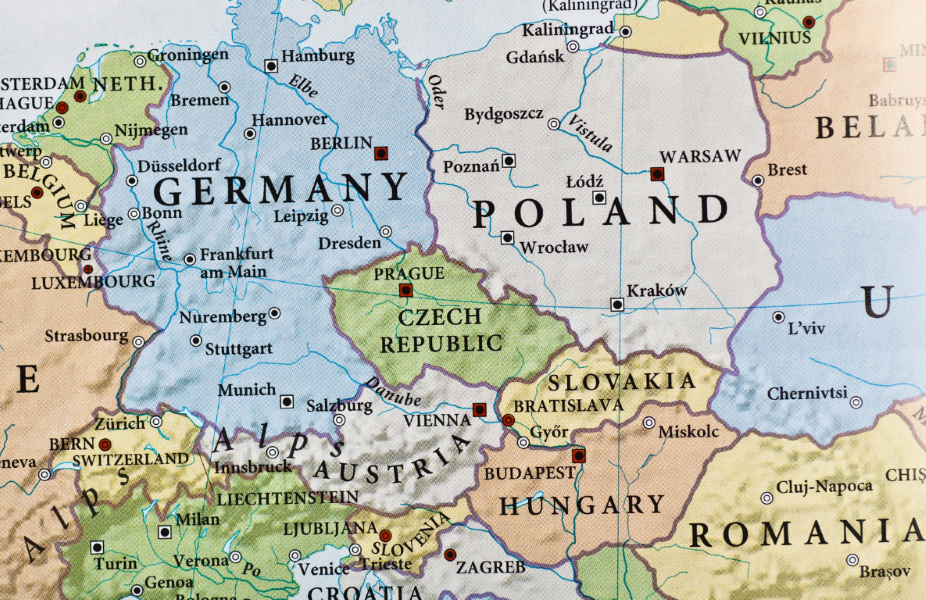
In Austria, Hungary, and Poland, the privileged status of gambling monopolies anchors the progress of each market. Yet legal experts have noted that monopolies and their critics must find common ground in a new generation of challenges and sensitivities.
The power dynamics conferred on state monopolies have shaped the politics of gambling across these Central European states for decades. But the rationale underpinning monopoly privileges is set to meet a breaking point in each market.
The question is no longer whether monopolies can be justified by law, but whether governments, regulators, and courts are prepared to reform the legislative frameworks that sustain them and finally transition towards a new commercial, competitive order.
Current tensions were laid bare at the HIPTHER Prague Summit 2026, where market insiders warned that CE jurisdictions remain well behind the broader European regulatory curve, irrespective of the privileges afforded by long-sustained monopoly systems.
Dr. Christian Piska, Professor at the Faculty of Law at the University of Vienna, put it starkly: “In Austria, we have arrived at a point that can only be called totally down”, describing what he sees as “no progress but only poor policy direction for everyone”.
Such criticism, he argued, is warranted. Austria remains the only EU member state yet to meaningfully regulate online gambling, or even attempt to do so. Despite the Court of Justice of the European Union (CJEU) insisting that monopoly systems must have a systematic and consistent approach to online gambling, with no exclusivity granted to one party.
A decade of debate has seen neither the government nor the political parties present a credible plan to repeal the online privileges granted to Casinos Austria AG and its online subsidiary, Win2Day.
For Piska, Austria has become “Europe’s fallout market…forget about Germany”. “If you’ve got 70% illegal gambling,” he said, “that cannot, of course, be a systematic approach to any framework”.
The critique extends beyond legal theory. Monopoly rights, Piska noted, are effectively “granted by just one paragraph of Austrian law”, rooted in the 1989 Law on Games of Chance, a condition that no court has challenged.
Meanwhile, political will remains conspicuously absent. For all the rhetoric surrounding reform, “Austria continues to be forever trapped between legal obligation and political reluctance. No one should bank on any forthcoming changes.”
If Austria is a case of inertia, Poland is one of contradictions. The government maintains that its framework is liberal, yet the state-owned Totalizator Sportowy continues to control the online casino vertical. The result is a system that preserves monopoly logic while failing to eliminate the distortions it was designed to prevent by changes enacted in 2017.
Dr. Justyna Grusza-Głębicka highlighted the structural weaknesses of enforcement. “In reality, enforcement is very difficult,” she said, noting that cross-border operators remain largely beyond the reach of Polish authorities.
Legal mechanisms exist, but their application is inconsistent as Poland continues its policy of “entrapment of players who gamble on grey online casinos”.
Furthermore, Poland imposes a number of burdensome conditions on its legal sector. Taxation, compliance, and product restrictions all reinforce monopoly advantages. Yet, paradoxically, competition has survived – and even expanded – in sports betting, the only segment of the market that has been partially liberalised.
Polish igaming lawyer Marek Plota observed that this has produced an uneasy equilibrium. Incumbents have adapted through scale and marketing, maintaining relatively strong channelisation rates despite a 12% turnover tax widely regarded as punitive. But the system offers little encouragement to new entrants. “There are no newcomers,” he remarked. “There are only outcomers.”
“In 2017, there were 23 licences, only 17 are active now, and only four have reported profits,” Plota asserts.
The result is a dual market: a functioning legal betting sector alongside a substantial offshore casino economy operating beyond regulatory control. Polish authorities are well aware of this imbalance, yet momentum for reform, particularly in online casinos, remains absent.
On paper, Hungary appears to have taken a different path. Legislative changes introduced in 2023 were intended to open the market and end the exclusive position of Szerencsejáték Zrt – the all-encompassing state operator (lotteries, online games, and sports betting). Yet three years on, the anticipated wave of competition has failed to materialise.
The explanation lies less in intent than in design. Hungary formally opened its market on 1 January 2023, birthing a framework of restrictive conditions that has deterred all competition from taking a Magyar licence.
Eligibility rules exclude companies that offered unlicensed gambling in any European Economic Area country within the previous five years—effectively disqualifying many established firms that previously operated in EU jurisdictions.
Online casinos remain tied to domestic land-based concessions, viewed as a buffered layer of state control. Combined with high financial thresholds and operational requirements, the result is a market that is open in theory but contained for Szerencsejáték Zrt.
Dr. Gábor Helembai argued: “Three years since new legislation, and no competitor has arrived on the market.”
Hungary’s enforcement-led model has delivered partial gains. “Blocking the payment, the ads and the websites,” he noted, “has helped increase channelisation,” helping Szerencsejáték Zrt. income reached the €1bn mark – yet Helembai noted that you cannot distinguish whether “performance reflects effective enforcement or simply the absence of viable competition… Truth is, we have no idea about the size of the black market”.
In 2026, the direction of travel remains uncertain. Austria is unable to escape a monopoly that appears increasingly indefensible to stakeholders. Poland maintains a system that works in parts but is an abject failure in consumer protection. Hungary hardens its enforcement to shape a market of little appeal to foreign investors.
Monopoly matters continue to affect Central Europe’s gambling outlook. But their future will depend less on legal privilege than on their ability to compete in markets where stakeholders no longer respect patience.
#Gambling #iGaming #MonopolyMarkets #Regulation #Austria #Poland #Hungary #OnlineGaming #ConsumerProtection #GamingIndustry

Welcome to Gambling Consulting Authority (GCA) - Your Strategic Partner in Gambling Industry Advancement